
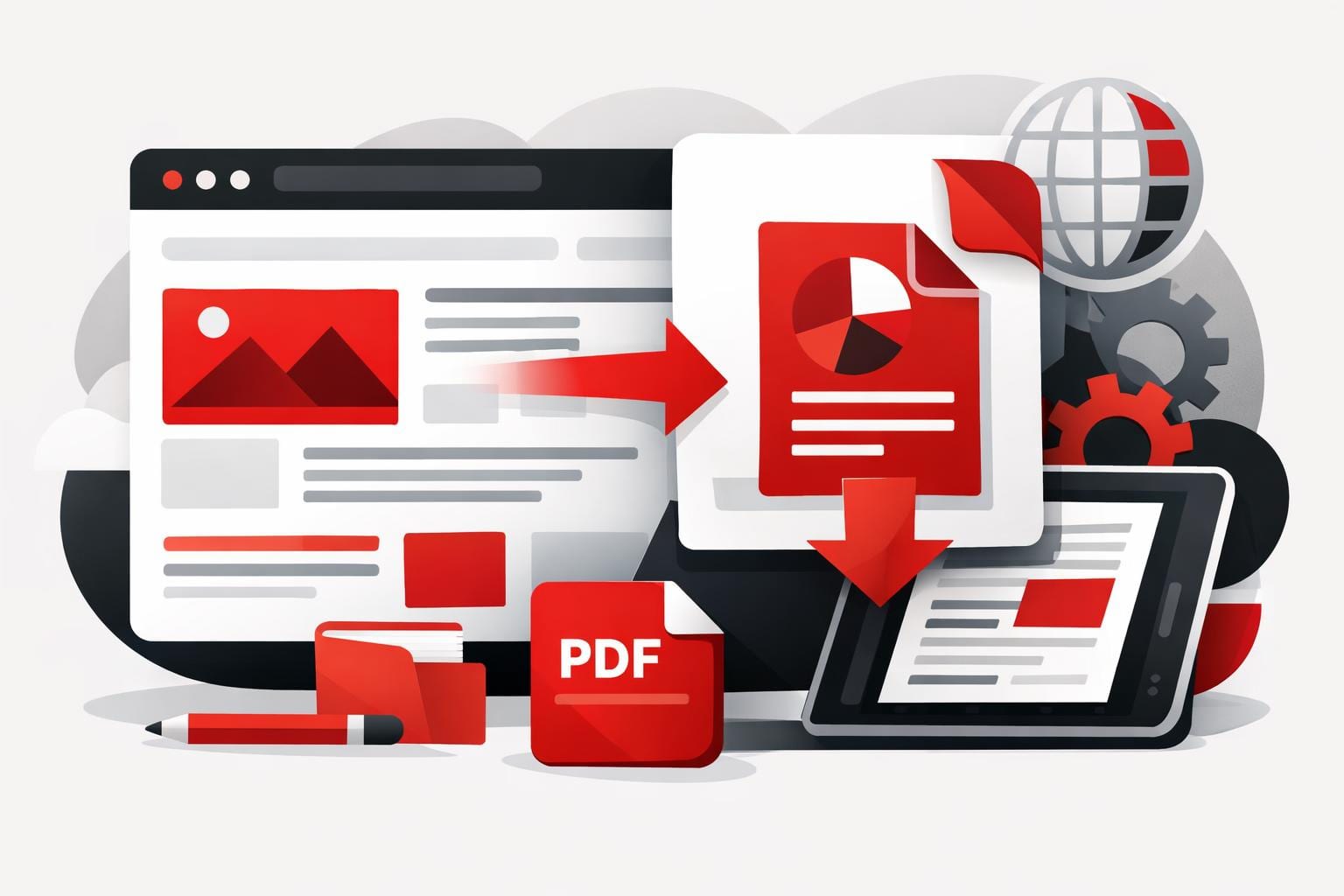
To share a web page as a stable, markable document, converting it to PDF is the fastest way to lock in the layout, keep it readable offline, and make annotations practical. Tools like iLovePDF’s HTML to PDF converter are built for capturing a full scrollable page in one export, instead of stitching together screenshots.
When a link stops being enough
Sending a URL is fine when the goal is “go read this.” It breaks down when the recipient needs the page to look identical later, or when the content must be reviewed like a document.
- Fixed layout, a PDF preserves formatting, spacing, and pagination for review and archiving.
- Offline access, the content remains available on a laptop during travel, in meetings, or in low connectivity environments.
- Markup ready, a PDF is easier to comment on, highlight, and circulate across teams than an ever changing page.
Concrete example: a procurement coordinator needs sign off on a vendor’s pricing page. A PDF snapshot creates a durable record that can be highlighted, circulated for approval, and stored with the final contract file.
Turning a web page into a PDF in minutes
iLovePDF’s HTML to PDF tool supports multiple inputs: a live website URL, uploaded web files like HTML, CSS, or JavaScript, a ZIP for multi file pages, or pasted HTML text. For most business use cases, URL conversion is the simplest path.
Fast URL conversion workflow
- Open the page in a browser and copy its URL.
- Go to HTML to PDF and paste the URL.
- Run the conversion and download the resulting PDF.
Settings that change the result
Web pages are responsive, meaning they reflow based on screen width. The converter exposes controls that can materially change readability and how much content lands on each page.
- Screen size, use a desktop width to avoid cramped mobile layouts in the exported PDF.
- Page size, choose A4 or US Letter based on how the PDF will be printed or filed.
- One long page, useful for reports and articles where continuous scrolling beats page breaks.
- Margins and orientation, adjust for printing, binding, and wide tables.
- Cleaner capture options, settings such as blocking ads or removing overlay popups can reduce clutter on the exported document.
What to do after the PDF is created
A good “web page to PDF” flow rarely ends at download. The practical win is chaining the next step immediately, depending on what the team needs.
Make it easier to email and store
If file size is the problem, compress before sharing. iLovePDF’s Compress PDF tool lets users choose a compression level, trading size against quality.
Turn the snapshot into editable text
If the goal is to reuse content in a draft, converting to Word is often faster than copying from a browser or retyping. The PDF to Word converter also flags scanned pages where OCR may be needed, since images of text are not inherently editable.
Package supporting pages into one deliverable
When the PDF is evidence, for example a pricing page plus terms plus a product spec sheet, merge everything into one file. The Merge PDF tool is designed for drag and drop ordering before combining.
What happens to uploaded files
Any online converter is also a data handling decision. iLovePDF publishes its security and retention approach on its Security and Data Protection page and central legal documentation at Legal information.
- Encryption claims, iLovePDF states it uses HTTPS and also describes end to end encryption for document handling.
- Short retention for standard tools, iLovePDF states files processed on the platform are automatically deleted within two hours, and it also describes a manual delete option from the download screen.
- Exceptions for signing workflows, iLovePDF notes that signed documents may be retained longer to meet legal requirements.
For compliance focused teams, iLovePDF also outlines its broader posture, including GDPR alignment and ISO certification references, in its PDF compliance and GDPR hub. Policies change, so the safest practice is to treat these pages as the source of record during vendor review.
A decision rule that avoids rework
Most teams waste time by choosing the format first, then fighting the consequences later. A simple rule prevents that.
Decision rule: if the recipient must see the same content later, in the same layout, without relying on the internet, export to PDF. If the content must remain live, current, and interactive, share the link.
A quick comparison of three sharing options
| Option | Best for | What it gets wrong | Typical effort |
|---|---|---|---|
| Send a link | Fast sharing, always current | Layout can change, content can disappear, hard to annotate consistently | Low |
| Take screenshots | Small snippets, visual proof | Breaks on long pages, messy to stitch, text becomes less usable | Medium to high |
| Export to PDF | Review, markup, offline reading, archiving | Becomes a snapshot, not a live page, may need tuning for responsive layouts | Low to medium |
A memorable mini model for choosing the right approach
- Fidelity, does the exact layout matter, including tables, footnotes, and spacing?
- Actionability, will the file be edited, commented on, merged, or attached to a ticket?
- Exposure, how sensitive is the content, and does policy allow uploading to an online tool?
When fidelity and actionability are high, PDF is usually the right container. When exposure is high, the format decision should be paired with a processing decision, using documented security practices and internal policy before uploading any file.